Cosplay Surcoat/Outer Tunic
May. 18th, 2024 10:38 am![[personal profile]](https://www.dreamwidth.org/img/silk/identity/user.png) flintheath_as
flintheath_asIn preparation for a convention this summer, I decided to make a cosplay outfit of one of my favourite webcomic characters: Sky from Linked Universe. Conveniently, the artist of the webcomic shared some concept art showing the (many) layers of his costume, so I could use them as a reference.
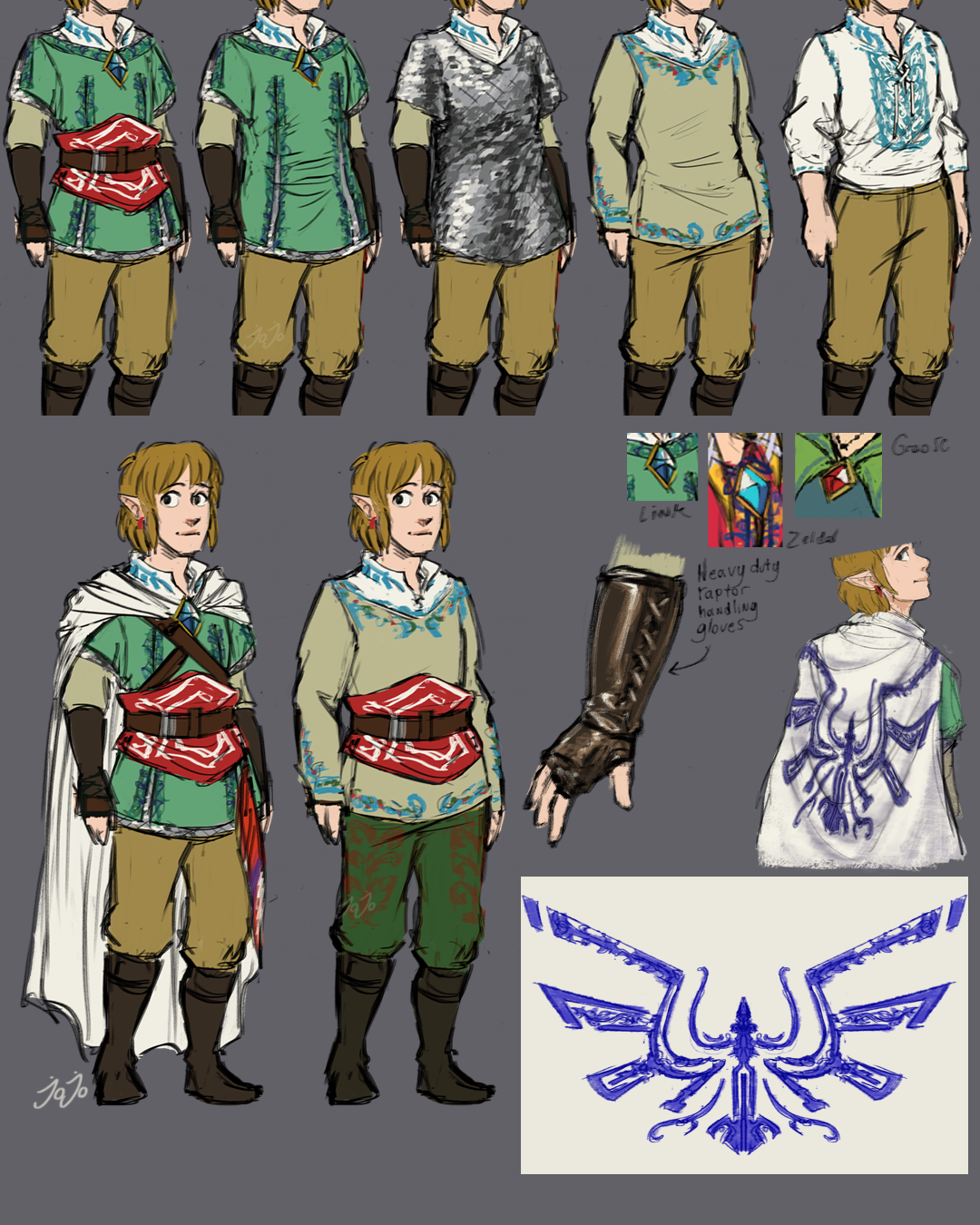
(Source)
I decided to ignore the pale-green outer shirt and the chain mail, leaving me with trousers, the outer dark-green tunic or surcoat, and the shirt as well as some accessories.
First, I decided to make the surcoat (party because if the worst came to the worst I could fake most of the rest).
Issues
The main complicating issue was the embroidered trim around the slits and collar on the surcoat. The exact design is unclear both in the concept art and the comic itself. It appears to be an intricate leaf pattern:

(Source)
But the exact design changes in different panels.
Given that I'm also not confident in my ability to do a good job on that amount of embroidery (or my patience for the amount of time it would take), plus the fact that I had several other pieces to make, I decided this part of the design would have to be simplified. I decided to decorate the slits and collar with plain blue facings instead.
Process
Given that the underlying shape of the surcoat is fairly straightforward, I used a t-tunic as the base.
T-tunic Instructions
- Find a t-shirt with a good fit (bearing in mind that t-shirt material stretches and woven cotton or similar fabric does not). Since this garment is supposed to be loose-fitting and has a layer under it, I used the largest t-shirt in my wardrobe.
- Measure the length required. The surcoat goes to Sky's upper thigh, so I measured from my shoulders to about mid-thigh to allow a bit of extra length if needed.
- Fold the fabric so there's the right length from the fold to the edge.
- Lay the t-shirt on the fabric with the shoulders across the fold and draw around it, allowing a seam allowance. I had been intending to do French seams, which requires a seam allowance of about an inch, but forgot when measuring and only allowed half an inch of seam allowance.
- The surcoat is longer than the average t-shirt, so the lower part of the surcoat has to be eyeballed. Since it goes past the hip, it needs some extra flare (this is especially important in tunics that don't have slits) otherwise it will be too tight around the hips and legs.
- The measurements should also leave enough space at the bottom and cuffs for hems (though I ended up finishing the edges with bias binding)
The size and shape of the t-shirt collar can't be used for the collar of the t-tunic because the t-shirt collar relies on stretch. This surcoat has a wide collar, so I measured from the hollows at the ends of my collarbones to get the width (any wider would risk it sliding off my shoulders) and allowed an inch at the back and three inches at the front. I then used curved rulers to mark out the shape of the collar facing, though this could be eyeballed and drawn on a fold to make it symmetrical. I made the facing an inch wide, allowing an extra quarter inch of seam allowance, and made it in two pieces so that I could use some offcuts of blue fabric (I also used offcuts for the other facings - they came from my heraldic surcoat. This meant that I couldn't use the usual method of cutting the head hole in the tunic and facing simultaneously after sewing it on, but it could still work.
The process for attaching the facings was much the same for the collar and all the slits.

Facing Instructions
- Pin the facing to the inside of the garment in the correct location, with the side of the facing that will be the outside (the right side) against the side of the garment that will be the inside (the wrong side). Note that this is different to the usual rule to sew right side to right side.
- Sew around the shape of the slit/head hole, keeping as close to where the cut will be as possible.
- Cut the slit/cut the head hole in the tunic, following the shape of the facing.
- This isn't such a concern for the slits, but since the collar seam is curved, cut chevrons out of the seam allowance. This is necessary because otherwise when the facing is folded to the outside the seam allowance will ruck up. It can be done carefully with fabric scissors, but it's quicker and easier with pinking shears if you have them. Be careful not to cut the seam.
- Turn the facing inside out so the wrong side of the facing is now against the right side of the surcoat. The facing will now be visible from the outside.

Fold the edges of the facing over and sew them down. This is extremely fiddly, especially around the tops of the slits, and might be best done by hand, but I used a machine.
I did a row of topstitch around each facing and the slits and collar themselves in green to add some interest, given that the original surcoat was embroidered.

(All these photos were taken in different lighting; I promise this is the same garment despite it looking like it's different colours!)
With the facings in place, the final steps are to sew up the sides and underarm seams of the tunic. I stabilised the fabric by sewing a zig-zag stitch on the edges after sewing the seams (having forgotten to leave enough seam allowance for French seams) -

- then finished with bias binding around the cuffs and hem both to provide an even edge (since I didn't trust my ability to hem by the same amount between slits) and to provide a bit of decorative edging, since my bias binding was a slightly different shade of green.
Different shades of green, it turned out, in a lesson about buying all the notions you need at the same time. It's fine, this is worn by an adventurer, repairs have probably been made to the trim.

Done!
